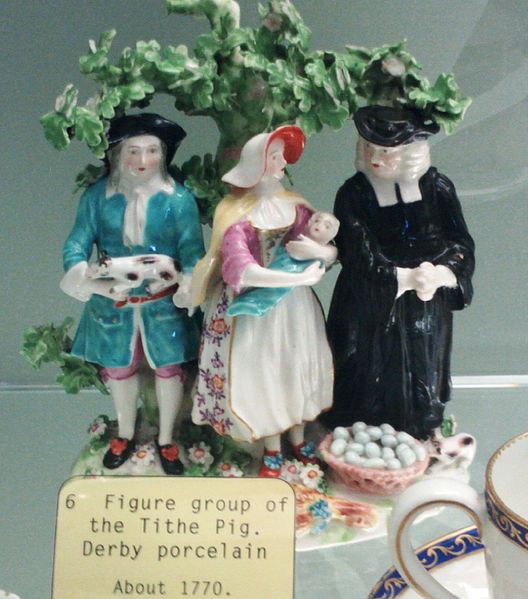
Victuallers / CC BY-SA (https://creativecommons.org/licenses/by-sa/3.0)
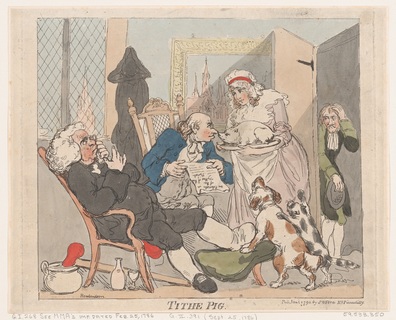
Thomas Rawlinson ‘Tithe Pig ‘1790 ‘ish. Metropolitan Museum of Art under Creative Commons.
With the exception of a few rural historians, cartographers and genealogists, most people today have never heard of that “tenth part of the annual increase of the produce of the land, the stock upon the land and the personal industry of the inhabitants” which was known to countless generations as the tithe. It was the first form of income tax and in practical terms it meant that if a farmer produced 500 bushels of grain [a bushel was 8 gallons or approx. 40 litres] he had to give 50 bushels to the rector of the parish. If his ewes produced 100 lambs then ten were given over, if he cut 100 stooks of hay ten were passed on and so on. The list of produce that was titheable was enormous.
The Origin of the Tithe
For the first five hundred years or so of the Christian church, no tithes were paid, indeed Christ himself said little about tithes, and that which he did say was somewhat condemnatory. The tithe was a product of the developing theology of the Roman Church at the end of the 6th or 7th century, nobody is certain precisely when. The tithe appears never to have been claimed by the Eastern Orthodox churches, and the sources cited in justification of the tithe were a few passages in the old testament. As this is a short history we cannot explore these texts individually but the following gives a flavour of them.
“And all the tithe of the land, whether of the seed of the land, or of the fruit of the tree, is the Lord’s: it is holy unto the Lord….. And concerning the tithe of the herd, or of the flock, even of whatsoever passeth under the rod, the tenth shall be holy unto the Lord. He shall not search whether it be good or bad, neither shall he change it”
Leviticus 27
As the early church grew it required money. It also required a deeper theology than was present in what we now call the New Testament. It found itself turning more and more to older texts and those found in Old Testament writings set the church elders thinking. It was noted that one of the twelve tribes of Israel, the Levites, had been paid a tithe by the other tribes. The Levites were tasked with providing and supporting the priests at the temple in Jerusalem , maintaining the fabric of the temple and giving alms to the poor. The Levites had to sustain themselves and since they could not fulfil their religious duties whilst farming the other tribes had to provide them with food – this it was said was the origin of the tithe. Or so it was thought by the theologians of the Roman church who began to see themselves in the same role as the Levites and soon found reasons in the bible why the tithe should be paid by the faithful, not simply as a voluntary offering, but by divine law, ordained by God, and inescapable.
The power of the church was such that this view went largely unchallenged until the 17th century when an English lawyer, John Selden, wrote a history of the tithe in which he denied it was payable by divine law although by this time he acknowledged that it was payable by the common law of England i.e that made by man. He was forced to appear before the King [James 1 & 6] and his Privy Council and made to retract his views and his book. But ideas don’t go away just because a King, even one who believed in the divine right of Kings, says so; there was always a lingering doubt that the tithe was not being claimed because God demanded it but because an avaricious church did. On 19th century historian of the tithe, himself a clergyman, would write “These canons [ecclesiastical laws] were framed and passed by ecclesiastics. The people who paid [the tithe] had no voice in the matter….Tithes were too profitable a source of income to be ignored in the Christian Church.”
At their inception, let us say the 7th century in Europe and later in England, such debates were irrelevant. Kings then were rarely so secure in their crowns that they could afford to ignore the support of an organisation which had such a powerful grip on men’s minds. Needing the support of the Church ancient Kings were often ready to agree to their subjects paying the tithe but the laity were not quite so keen: it was not until the reign of King Athelstan, the first king of a united England, that collection of the tithe could be ordered across the whole of England with some reasonable expectation that they would be paid.
Rectors
The tithe was always paid to the Rector of the parish which was simply the person, or organisation, legally entitled to claim the tithe. From the very outset the great lords, on whose land the produce of the earth was grown, were free to appropriate [give] the tithes of their manors [including the tithes of their tenants] to whomever they wanted and this was mostly to the abbeys, priories, convents, colleges of priests, and so on that dominated the countryside.
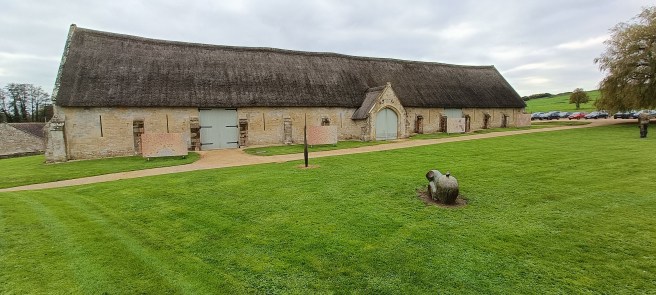
Until their dissolution in the 16th century, the monasteries were to remain the main recipients of the tithe but by the 13th century a change was already being seen. The prime activity of the monasteries was to pray; they were not overly concerned with preaching to the laity. Yet how was the strength of the Christian religion to be conveyed to the faithful in the numerous manors, villages, towns and so on? The answer was the development of the parish, its church and resident priest. In some cases the priest was provided by the monastery; a substitute if you will. In Latin ‘substitute’ is ‘vicarii’ and so we arrive at the term ‘vicar’. He received a small part of the tithe with the bulk going to the monastery which remained the rector.
In other cases by mechanisms and for reasons that are almost never known, the link between the monastery and the parish was broken and the parish priest became the rector in his own right claiming the whole of the tithe.
When the monasteries were dissolved under Henry 8 the King appropriated the monastic lands releasing some four million acres. Contrary to popular belief this land did not all go to Henry’s cronies at knock down prices instead the majority, perhaps two thirds of the land, together with its tithes, was given by Henry to support his newly established church. This is why so many ‘Cathedral churches’ became the rectors of parishes far distant from them.
Even so about a third of the old church lands fell into lay hands and Henry VIII was extraordinarily generous to them for he allowed them to retain the tithe on these lands. In so doing he created a new class of tithe owner – the lay impropriator. There may have been some theological justification for the church to receive the tithe but for the lay impropriators to claim it there was none. If pushed to it they might have the duty to pay for a curate at minimal expense.
Paying the tithe
Originally the tithe was paid “in kind” which meant that every tenth bushel of wheat , every tenth lamb , every tenth pail of milk etc etc was paid to the rector directly. This was known as paying ‘in kind’ but as the use of money grew it became more convenient for both the landowners [who paid the tithe] and the rectors or lay impropriators [who received it] to receive a monetary payment instead. These monetary payments were known as ‘compositions’; their nature, form and indeed the amount paid varied widely throughout the country and despite the overall trend towards money payment in kind persisted well into the 19th century with the tithe owner always retaining the right to demand the tithe in kind if he chose. Poorer rectors often agreed a payment with the landowners based on a flat rate per acre of land for a period of up to seven years. The risk with this approach however was that if the price of grain rose or fell sharply either the rector or landowner might lose out.
Finally in most parishes there was a curious payment known as a modus. Certain titheable produce, notably milk was difficult to tithe. In an era when milking was done in the fields there were clearly logistical difficulties for the rector to claim his tithe milk. The modus probably arose as an attempt to resolve this problem. In 1295 Robert Winchelsey, then Arch-Bishop of Canterbury, allowed tithing in kind of milk to be replaced by a monetary payment due on each ‘milch’ cow and heifer in the parish. For some inexplicable reason the value of this monetary payment never altered so that over the centuries it had become almost worthless. Worse still in some parishes other moduses were established which were so ancient that nobody could remember when or how they had arisen.
By the 19th century the value of moduses had fallen hopelessly behind the market value of the crop they were attached to. As a consequence they were loathed by rectors and the church but loved by farmers. In the late 18th and early 19th centuries the church made energetic efforts to overturn these moduses, there were innumerable legal cases seeking to do this, and an enormous amount of ill will was generated over it.
The value of the tithe.
It can be difficult to grasp just how important the tithe was. The power of the church today, is much diminished and the tithe itself has been long forgotten, even in rural communities. Throughout its history the tithe brought the church immense wealth. Precisely how much wealth it brought in the earliest centuries cannot be reliably known. The first assessment of its value came in 1831 [see below] when it swamped all other forms of income that the church received.
From the start the tithe built the monasteries, churches and cathedrals for which the church became famous. In an era when what impressed the secular world was impressiveness, these physical structures were undoubtedly impressive. But this was not all for the wealth of the church allowed it to be a major player in the political arena. There is no significant event in European history, let alone British history, that did not involve the church at the highest level. As Arnulf of Lisieux, a 12th century French bishop pointed out:
“King’s cannot attain salvation without the Church nor can the church without Royal protection obtain peace. Both are so bound together by the very necessity of their nature that each gains great strength from the other.”
What gained the church it’s seat at the top table was not just its teachings; the early church had achieved it’s spiritual conquest of the western world in the six centuries after Christ’s death, long before the tithe was first demanded. Had the church remained the ascetic church of these early centuries, it’s difficult to see how the subsequent history of Europe would have been the same.
It is generally said that the wealth of the church came from the land it acquired but this is shorthand and misses the point which is that land has no value unless it can be exploited. Think of all that middle eastern desert which had no monetary value until the coming of the internal combustion engine. Until comparatively recently the principal way of exploiting the land was to farm it.
The church therefore enjoyed three important advantages. Firstly they raised the tax on virtually the whole population. As it was due on agricultural produce in an era when pretty well everyone had to grow their own food, only the clergy themselves, the king and a few others were exempt from paying it. Secondly they claimed it annually. Not even Kings managed to achieve this; they had to rely on the intermittent, irregular taxation voted by parliament. Finally for any acre of land there was a maximum profit that could be drawn from it which had to be divided between the landowner’s rent, the tenants living and the tithe. If the church rented it’s own land to a tenant it got two parts of that profit- the rent and the tithe – but better than that it got one part of the profit from everyone else’s acre of land as well.
Just how much money the tithe brought in over the centuries can never be known but in 1831 a radical publication, ‘The Extraordinary Black Book,’ published anonymously in 1831 [for very obvious reasons] gave an unchallenged account of the church’s earnings. Today it does not sound much, a mere £9.5m, but at 2017 values that was the equivalent of some £644m ! Of that £9.5m one source, the tithe, contributed £7 m [£475 m], nearly three quarters of that income.
The need for reform
Over the centuries many groups had opposed the tithe. Some objected on theological grounds; the Franciscans and Lollards, in the 14th and 15th century, held that the clergy should not hold property of any sort; a position that was to create many problems for themselves in the process. The dissenting religious sects such as the Quakers which sprung up during the 17th century were later objectors. Their objections were based on the idea that the tithe was not payable by divine law and of course they did not support the established church. Several died in prison rather than pay it but they got their own back [sort of] as after the restoration of the monarchy Oliver Cromwell was dug up and his head impaled on a spike on London Bridge. There is a story that George Fox, founder of the Quakers, stood shaking his fist at it, saying “this is the price you pay for not abolishing the tithes”.
Those who opposed the tithe during the 18th and 19th centuries were a very mixed bunch and oddly enough the religious dissenters of an early century were not prominent among them.
The most influential opponents of the tithe were probably the members of the Board of Agriculture, of whom Arthur Young is the most famous today. Founded in 1793 it was, despite its official sounding name, a private organisation devoted to improving agriculture. It saw the tithe as being a barrier to achieving this. If a farmer improved his or her land the costs of improvement were born by them immediately. It could take several year to recoup the costs through increased profits yet the tithe owners took their share immediately long before the debt was repaid.
The farmers had most to lose of course and they were particularly sensitive to what was seen as the aggressive behaviour of the church and lay impropriators in trying to overturn the numerous customary practices relating to tithe valuation of which moduses were the most egregious examples; all too often they were successful. The most famous of these cases, was brought at Kendall in 1817 when a tithe of £300 a year was replaced by one of £2,156 following a case brought by Trinity College Cambridge. The costs to both sides amounted to some £15,311: the tithe owners recovered that within a few years. For the landowners and farmers it was money lost for ever.
The Extraordinary Little Black Book gave voice to the prevailing attitude to the church of the time:
“It is unseemly, we think, and inconsistent with the very principles and purposes of Christianity, to contemplate lofty prelates with £20,000 or £40,000 a-year, elevated on thrones, living sumptuously in splendid palaces, attended by swarms of menials, gorgeously attired, and of priests to wait upon their persons, emulating the proudest nobles, and even taking precedence of them in/ all the follies of heraldry. Beneath them are crowds of sinecure dignitaries and incumbents, richly provided with worldly goods, the wealthiest not even obliged to reside among their flocks; and those who reside not compelled to do any one act of duty beyond providing and paying a miserable deputy just enough to keep him from starving”.
Reform
Any pretence as to a theological justification for the tithe had, by and large, disappeared by the late 18th century. When it was introduced the tithe was expended in what was called ‘The Levitical tradition’. It had seen the tithe used for three purposes: one part was retained by the clergy for their maintenance, another part for the maintenance of the church and a third for alms to the poor. Later, the local bishop would take a share. Nominally at least each party claimed an equal share but from the outset this was not how it turned out. By 1800, clerical alms giving had virtually ceased, although their glebe land was liable for the poor rate; the maintenance of the church, with the exception of the chancel, had been passed to the laity centuries before so that the rector now claimed the whole of the tithe for his support.
Even in this respect though the tithe failed. The Extraordinary Black Book’s story of clerical high living was only part of the tale since clerical poverty was widespread. In 1704 a survey of some 11,000 church ‘livings’ showed that just under a half were worth less than £100 per year with just under a quarter being worth less than £30. Not a lot it might be thought until we consider the wages of an agricultural labourer which in Dorset even in the mid-19th century came to less than £20. The Queen Anne’s Bounty had been established to support the numerous livings worth less than this and was raised from within the church. It barely managed £15,000 per year.
Dissatisfaction with the tithe and the Church more generally, in the view of the late Eric Evans, Professor of History at Lancaster University brought it close to disestablishment in the early 19th century. The biggest barrier to reform had nothing to do with theological questions; it was all about the money or more correctly ‘property’.
When asked to define what they mean by property most people give examples of tangible objects, cars, houses, phones and so on but in fact the only thing to define an object as property, is the body of law that surrounds that object. It turns out that with appropriate laws, and a society ready to enforce them, anything can be turned into property.
Most farmers probably thought of, let us say, the tenth lamb as their lamb, which they then gave to the tithe owner. The law though saw it differently. That tenth lamb was never the farmers, even though his ewe gave birth to it and he cared for it and fed it. That lamb, from it’s very conception, was the property of the tithe owner. If he didn’t give it up the farmer was effectively stealing from the tithe owner. It had always been claimed that the tithe had to be paid because of divine law but centuries of custom had rendered it liable to be paid under the common law and tens, if not hundreds of thousands of cases, had produced a body of law, a cocoon if you will, that surrounded and shaped the tithe. That law could not simply be ignored. Even though the common law could be abolished by statute law [passed by act of parliament] it was out of the question that the property those laws had protected should ever be abolished. The same question arose with slavery. The enslavement of people could be abolished but those who had already been enslaved were someone’s property. They could not simply be released, which would be tantamount to the abolition of property, their owners had to be compensated for freeing them. And if slaves as property could not be abolished there was little chance that the tithe would be either.
Nevertheless the tithe was reformed in 1836 by replacing all forms of tithing with a single monetary payment known as the tithe rent-charge. This did not abolish the tithe it simply replaced it. The Tithe Commutation Act of 1836 is discussed in more detail here and began a century of gradual change to the way the tithe rent-charge was claimed. In the short term the Act was successful although numerous amendments to the legislation had to be made.
After the first world war however the position of the tithe once again became unsustainable but once again it could not just be abolished. A century on from the TCA another act The Tithe Redemption Act [1936] introduced a mechanism which would see the ultimate demise of the tithe. By this time collection of the tithe rent-charge was in the hands of the Queen Anne’s Bounty and the government undertook to loan the Bounty an amount of money which, once invested would yield the same amount as the total tithe rent-charge due that year.
Farmers were required to invest in an annuity which would, after sixty years repay their share of the loan and if they sold their farm a redemption fee was taken from the sale price. In the event the stock market did so well that in 1976 the government announced that the loan had been fully repaid, the farmers ceased payment into the annuity; the final remnant of the tithe disappeared and today over a thousand years of history has been well and truly forgotten.
Page last updated 30/07/2025
Next Pre-Commutation Work
Previous Inclosure Parish by Parish
 John Martin of Evershot