Although resentment had grown towards the established church in the early 19th century abolition of the tithe was never seriously considered. The country was still religiously observant and the symbiotic relationship between church and state was still strong. It was also recognised that no matter how strong their faith, the population, left to their own devices, would rarely give enough of their earnings voluntarily to maintain the church in the way that both church and state thought was its due.
Abolition of the tithe was impossible, not because of any religious scruples a man or society might have. It was simply that it was anathema to abolish any form of property. The French of course had abolished the tithe in 1789 and although the ‘terror’ could hardly be blamed on that you could see why the English establishment were not enamoured with the idea. If you abolish one form of property, they asked themselves, where will it all end? Nobody sought to question the moral basis for what could or could not be property that was irrelevant. If the law said some ‘thing’ was a form of property then it was and to deprive the owner of the property of that ‘thing’ was no more or less than theft.
Several abortive efforts had been made to reform the tithe before the passage of the 1836 Tithe Commutation Act [hereafter the TCA]. According to Prof. Eric Evans “In each of the parliamentary sessions of 1833,1834,1835 and 1836 a major Bill to commute tithes was introduced by the government of the day.” Only the 1836 act succeeded even though it was virtually a carbon copy of the 1835 act.
The TCA established a process whereby the tithe, no matter in what form it was paid, would be for ever extinguished [commuted] and replaced by a monetary payment, known as the tithe rent-charge. Before the passage of the act tithe could be paid, ‘in kind’, with actual agricultural produce, or by a traditional monetary substitute known as a modus, or by a monetary payment, known as a composition. It sounds simple but the reality was that there was an almost infinite variety of arrangements to pay the tithe. No two parishes were alike and even adjacent parishes could have quite different arrangements. All this was to be swept away and across the country all the myriad of ways of paying the tithe would be replaced by a single uniform method – the tithe rent-charge.
The principle of the rent-charge was nothing new. For centuries the rent of land and property had been related to the price of ‘corn’, which in the context of the TCA meant the price of oats, barley and wheat. Such ‘corn rents’ ensured that when the farmer’s profits rose in line with the price of corn, so did the landlord’s rent. The rent-charge as set by the commutation process was no more than an index value. Only if the price of corn remained as it had been at Christmas 1835 would the rector be paid the precise amount of rent-charge, otherwise the actual amount paid to the rector would vary according to whether that year’s price of corn had gone up or down compared to the 1835 price.
As well as simplifying the method of payment the TCA had other consequences. The first was that it encouraged farmers to invest in agricultural improvement, just as the agricultural reformers had wanted. Special rules were introduced to encourage the growth of new produce such as hops in areas where they had not previously been grown but a far greater effect resulted from the increased output of existing crops.
Previously if a farmer, as a result of improving his land achieved an increased output of [say] wheat the tithe owner claimed an immediate tenth of the output even though the farmer might not have paid off the debt incurred improving the land. The effect of this was to stifle attempts to improve agriculture. The TCA effectively stopped this by linking the rent-charge to the national price of corn and not the actions of any individual farmer. It is doubtful though if either farmer or tithe owner foresaw what would happen next. As output increased as a consequence of agricultural improvement so the price of corn fell. The farmer may not have made as much money from an increase in output as he or she had hoped but at least they had more wheat to sell: the tithe owner’s fortunes were however tied to the price of wheat and they did not do so well.
Before commutation the value of the tithe had been estimated to be some £6m, slightly lower than the estimate from 1831 quoted in the Extraordinary Black Book. The process of commutation took a decade or so and had been largely completed by 1850 when the value of the rent-charge was found to be £4m. I have not seen the difference explained anywhere.
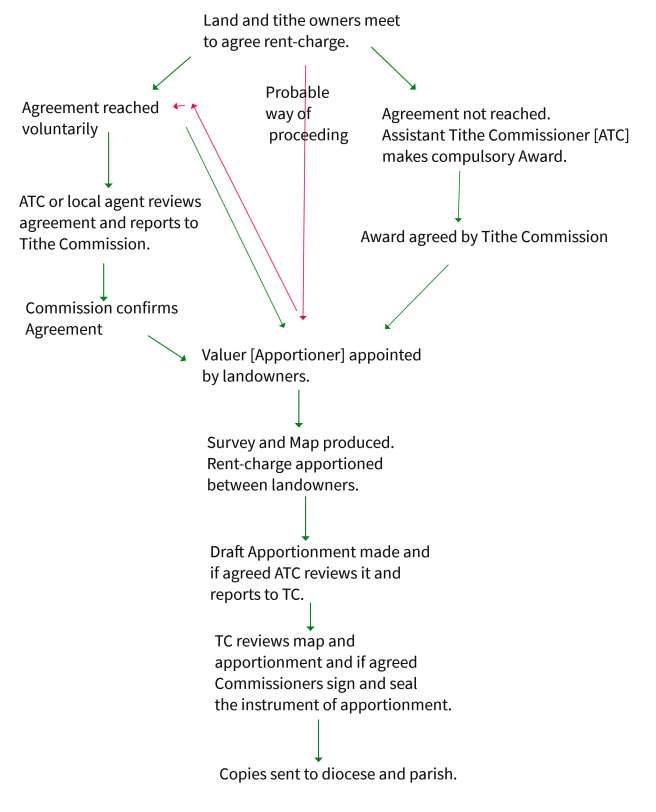
The commutation process was conducted parish by parish and various steps were involved:
1] AN INITIAL MEETING was called by either the tithe owner or the landowners of the parish. So long as two thirds of the tithe or landowners were present they could proceed to….
2] AGREE THE AMOUNT OF RENT-CHARGE to be paid. This was calculated for the whole of the parish and was based on the average value of the tithe that had actually received in the seven years prior to Christmas 1835. No doubt receipts and accounts were presented on both sides to prove the claims but the aim was that the value of the rent-charge would be agreed voluntarily between all parties. Once agreed a draft agreement was drawn up, in standard form, and sent to the Tithe Commission in London. It was almost certainly the case that a professional land surveyor or valuer was appointed although officially they were introduced at a later stage in proceedings. The process was simply to complicated to be left to amateurs.
If an agreement could not be reached the Tithe Commission was empowered to appoint an Assistant Tithe Commissioner with the authority to impose an agreement. This placed great power in the hands of the rector should he choose to exert it – blackmail might be too strong a word but there were certainly advantages to be gained by negotiating ‘vigorously’ with the landowners. The ATC had to be seen to be fair and he had the power to order a completely new [and expensive] survey of the parish to be made and a new [and expensive] first class map to be produced. Dire warnings were issued to the landowners to come to an agreement, almost at any cost, since the alternative might be much costlier in the long run. Following a voluntary agreement the next step was to have…
3] AN INDEPENDENT ASSESSMENT of the Agreement made. The tithe commission appointed a local agent, usually an independent land surveyor, who came to the parish to assess both the fairness of the agreement and the state of agriculture in the parish. He compiled a report that was sent to the Tithe Commission and added to the parish’s ‘Tithe File’. It did not form any part of the final agreement and apportionment but was retained as supporting evidence of the fairness of the process. If satisfactory the Tithe Commission gave the landowners a green light for the next stage which was the,
4] APPOINTMENT OF A LAND SURVEYOR. The complexity of the process was such that the surveyor or valuer had already been appointed. The choice was entirely down to the landowners. Sometimes a man might be appointed as the surveyor – to draw the map, or as valuer to apportion the rent-charge, or to do both. John Martin was the valuer in 39 of Dorset’s commutations but only drew 27 of the maps. Of the two roles that of valuer was the more important as only professional valuers could present the final agreement and apportionment to the Tithe Commission. As the two roles frequently overlapped I shall refer here to the surveyor only. They had several tasks to undertake:
a] Production of the final agreement: Using an official template the surveyor had to produce the final written agreement between the tithe and land owners. Generally this does not seem to have varied much from the draft agreement. Under this heading the surveyor also had to give a general description of the parish. What was it’s total area? What part of that was subject to the tithe? What were the areas of arable, pasture, meadow, waste and coppiced woodland? A full description of any moduses had to be included. Finally what was the agreed amount of rent-charge to be paid. The earlier commutations also included a rather complicated table. This was intended to be used to adjust the amount of rent-charge payable in future years.
It worked like this: the amount of rent-charge was divided into three equal parts and the table showed how many bushels of wheat, barley or oats each part could have purchased at the prices of these cereals as of Christmas 1835. To show how this worked let us take the price of just one grain, wheat. Suppose the total rent-charge was £300 then one third part would be £100. Further suppose that the price of wheat had been £1. Then that £100 would have purchased 100 bushels of wheat.
Each year a question was then asked – how much rent-charge do I need this year to purchase 100 bushels of wheat. Had the price dropped in the year to 50p then clearly only £50 would be needed and that year the rector would receive just £50. If the price had gone up to £1.50 then he would have received £150.
Later commutations omit this table because somebody eventually realised that the answer could be found by averaging the percentage rise in fall of the price of each individual grain compared to the 1835 price and then multiplying the rent-charge by this percentage.
b] Production of the tithe map. More will be said about this on the section on tithe maps but here for the moment it is sufficient to know that there were two classes of maps. First Class maps were produced from new surveys conducted to a scale that was sufficiently large enough to allow accurate measurements to be taken from it. Second Class maps, drawn to a smaller and thus inaccurate scale.
c] The apportionment document. The rent-charge having been decided a part of it had to be assigned to each landowner. How this was done is one of the mysteries of commutation. The principles adopted by the surveyor in regard to apportionment had to be supplied to the Tithe Commission and were added to the tithe file for the parish. Unfortunately these files were ‘culled’ and ‘weeded’ in the early 20th century to save space and such details as this were rarely retained.
Two questions had to be resolved. The first was simple enough. Before commutation each landowner had been responsible for a part of the tithe, a percentage of the total that had been paid. No doubt each would have been resolute in not paying more than their previous share. The second was more complicated. The TCA, as passed in 1836, allowed the landowners considerable latitude as to how their share of the rent-charge was apportioned. They could for example choose to apportion it across all their lands, or the whole charge could be applied to just one parcel, or they could apportion it so some lands and not others. It was an important decision and allowed the possibility, if the landowners chose to do so, for a redistribution of wealth. The poorest tenants could be exempted from their charge with their burden being taken on by the wealthier tenants. Whether the did so is not known.
The result of course was chaos as everyone chose to do their own thing: an amending act in 1840 limited their choices. In future the default method of apportionment would be to allocate a part of the rent-charge to every parcel of agricultural land in the parish and only if a majority of the landowners desired could an alternative method be used and applied to all landowners. Such requests had to be made in writing.
The apportionment document itself was usually hand written on an official template. Details included were the name of the landowner and the occupiers of the land; a reference number to the parcel of land concerned which was shown on the map; a description of the plot – house, pasture, orchard etc; the state of cultivation; the area of the land and finally the rent-charge assigned to it.
What ever method of apportionment was chosen the rent-charge stayed with that land for ever. Even if it was taken out of agricultural use or built on or used for the new railways its owner still had to pay the charge.
5] FINAL APPROVAL. Once the agreement and apportionment had been concluded it was sent to the Tithe Commission in London who appointed an Assistant Tithe Commissioner to meet with the landowners. Ostensibly it was to ensure that the process of commutation had been fair but to judge by the letter from the ATC [Aneurin Owen] who visited Child Okeford it was more to squash the minor complaints of some landowners thus ensuring a sensible outcome to what could become an intractable and interminable process. On receipt of the ATC’s report the Tithe Commissioners would ‘enrol’ the award by affixing their stamp and signatures to the map and award.
6] DISSEMINATION of the agreement then followed. Martin had provided an original apportionment document and map together with two copies. One was sent to the Diocese which had jurisdiction over the parish whilst the other was stored in the parish chest [shown below] until at some unknown date it was transferred to Dorset County Records.
Over the next few pages I describe the various parts of tithe commutation.
Next The Agreement
Previous A Very Brief History of the Tithe
 John Martin of Evershot